Conveau Platform

Competitor prices, catalogues and campaigns, scanned on a schedule and matched to your own portfolio.

Five modules in one workspace: the scan overview, like-for-like comparison, a radar of opportunities and threats, market discovery and an assistant that answers from the data. Sales Agent and Support Agent come as features of the same platform.

Start with one workflow. We reply within one business day.

One workspace for everything your competitors publish.

These are the product’s own screens, not illustrations of it.

Product screens from a demo workspace. Company names and figures are fictional.

Overview

Every scan ends in a short summary you can act on.

The platform reads competitor prices, rates, catalogues, campaigns and app releases on a schedule, compares each scan with the one before it and tells you what moved — in your favour or against you.

  • A change ledger per data set: new, changed, removed
  • Events sorted by impact, not by time
  • What it could not read is said out loud, never hidden
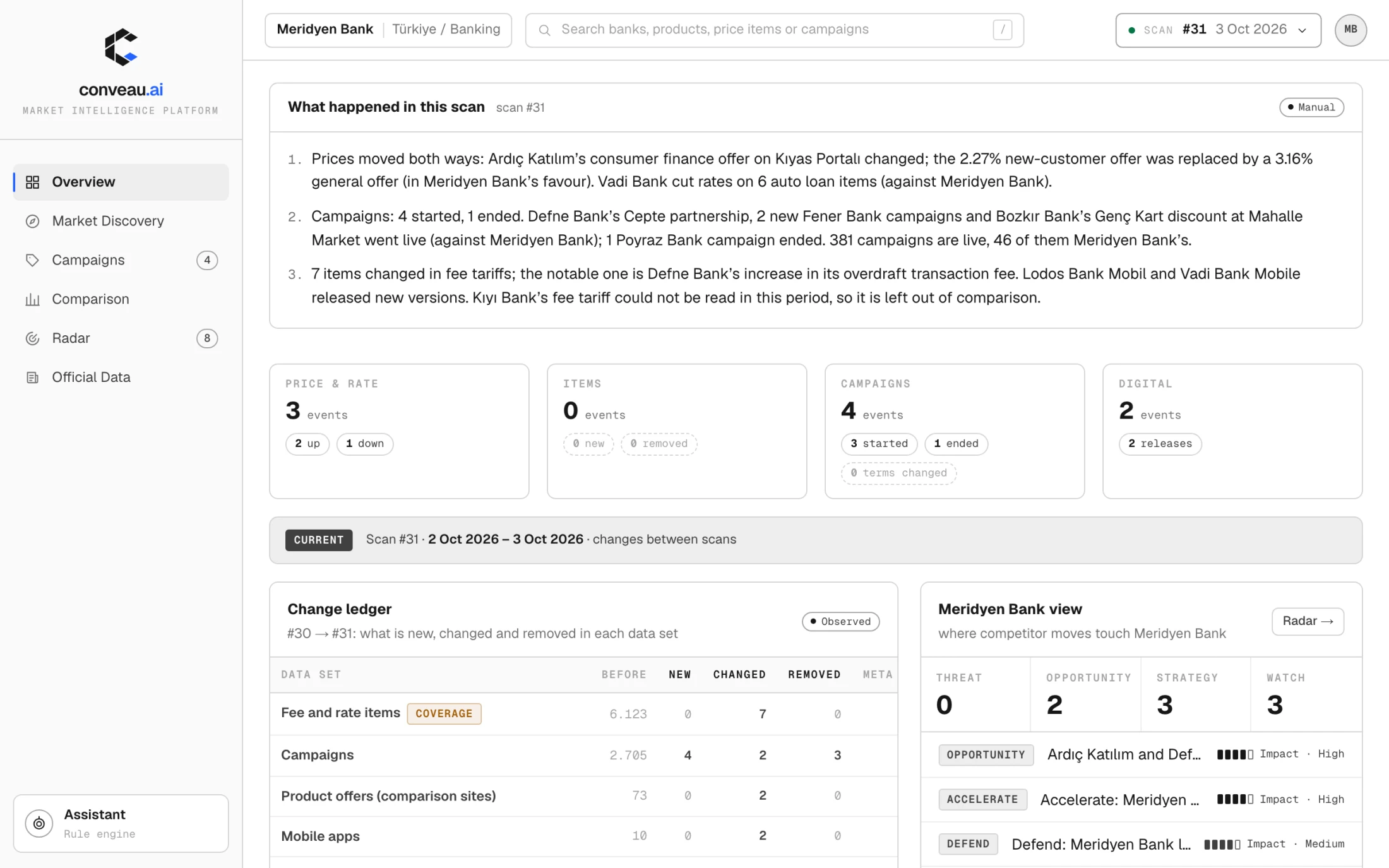
Conveau Platform overview: scan summary, event counters and the change ledger

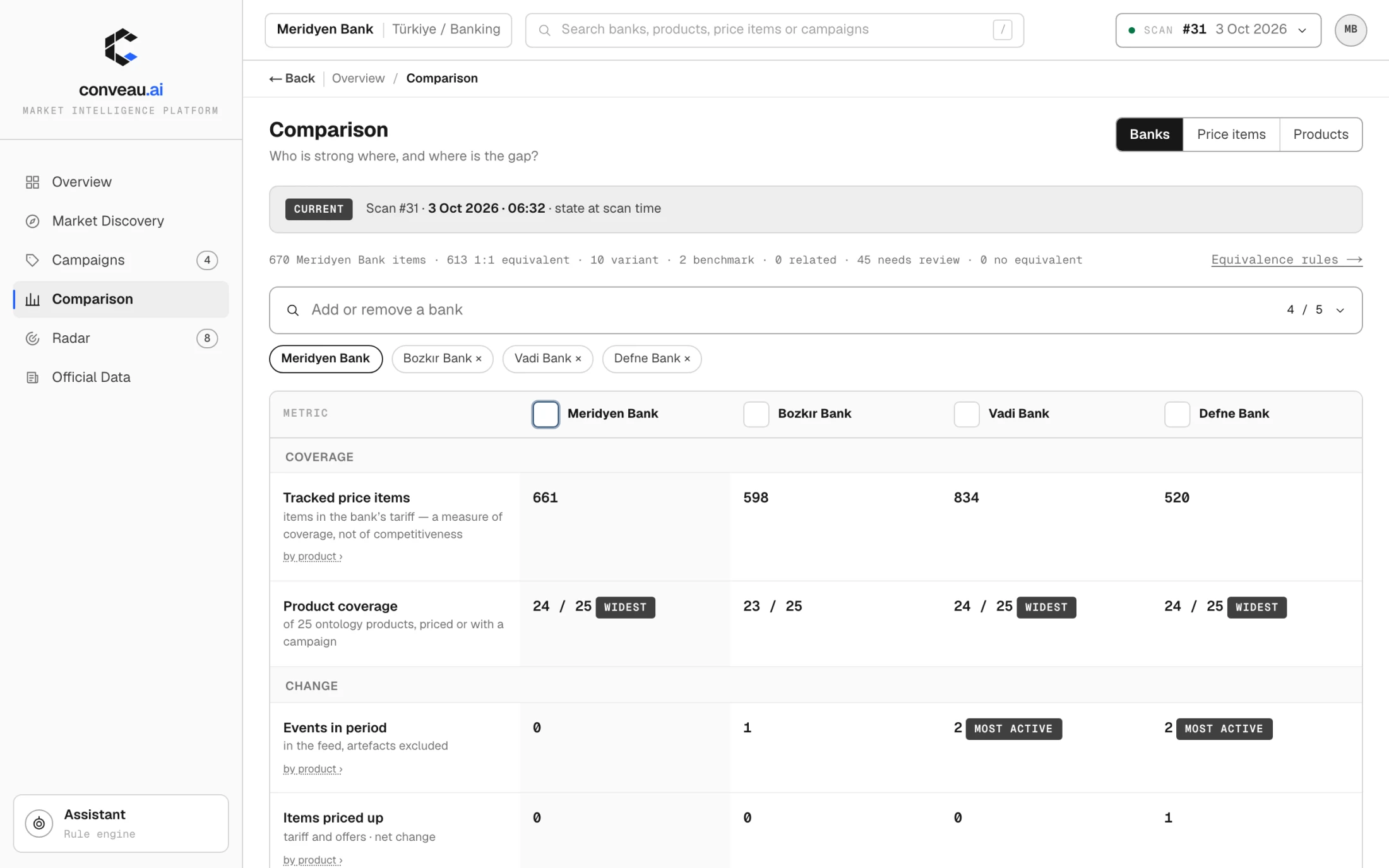
Comparison

Like for like, or it does not get compared.

Every item is matched to its equivalent before a number is put next to it: exact match, variant, benchmark group or "needs review". Your position is then read against the market median, per product.

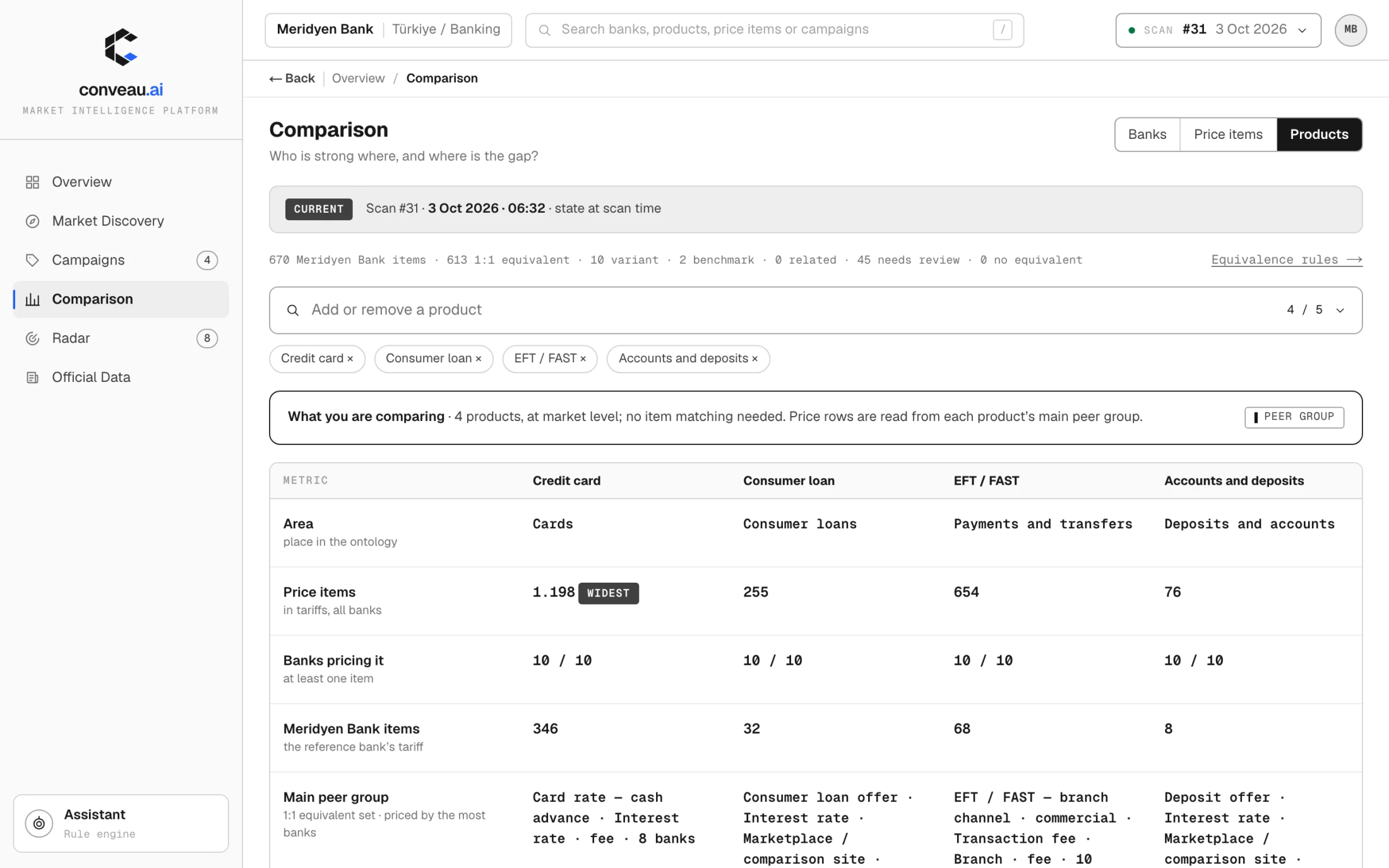
  • Competitors, price items or products — three ways into the same data
  • Your rank and distance from the market median
  • Matching rules you can inspect and correct
Comparison table of four companies across coverage, change and campaign metrics
Product-level comparison with market median and rank per product

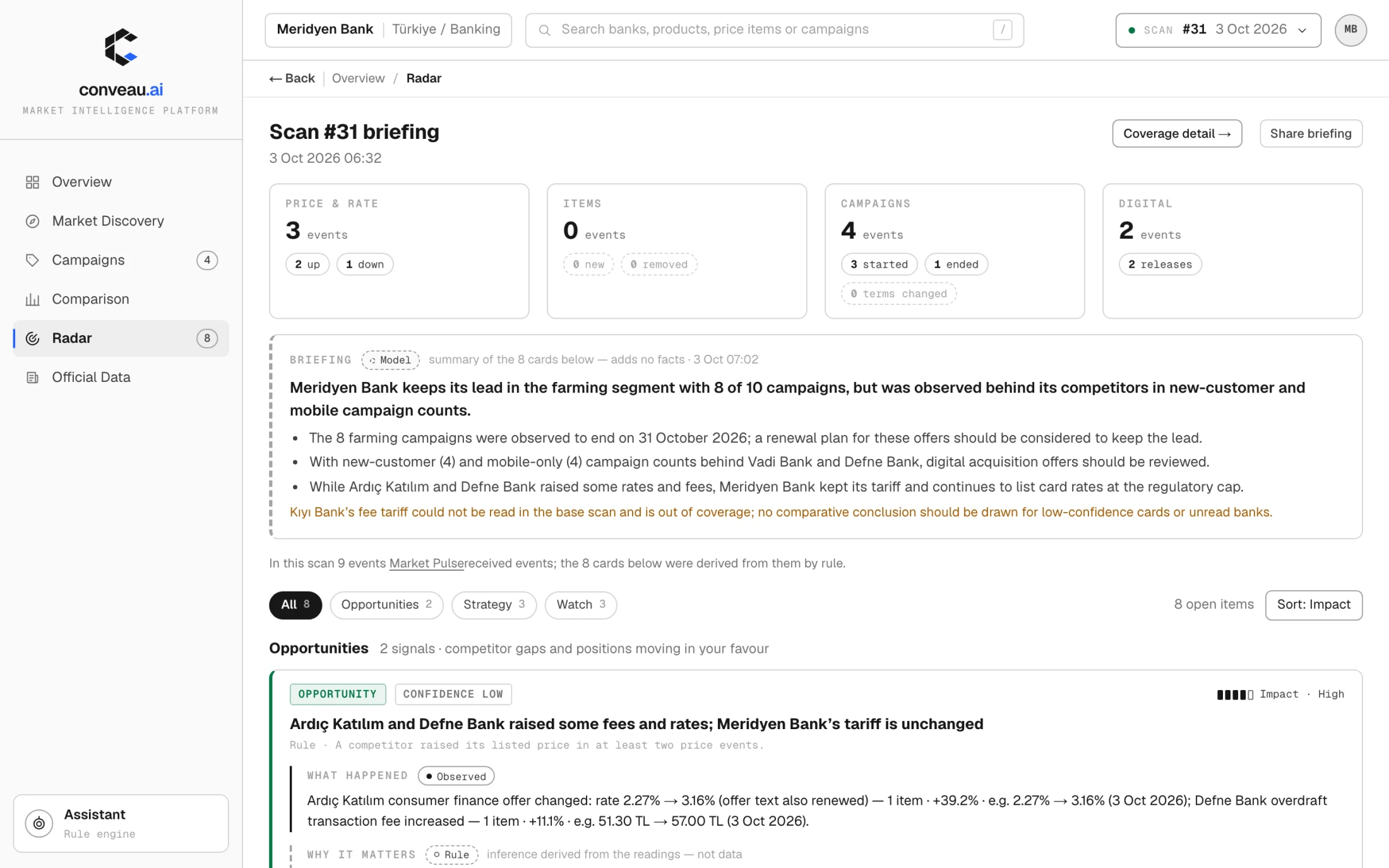
Radar

An opportunity is a claim. Radar shows the evidence under it.

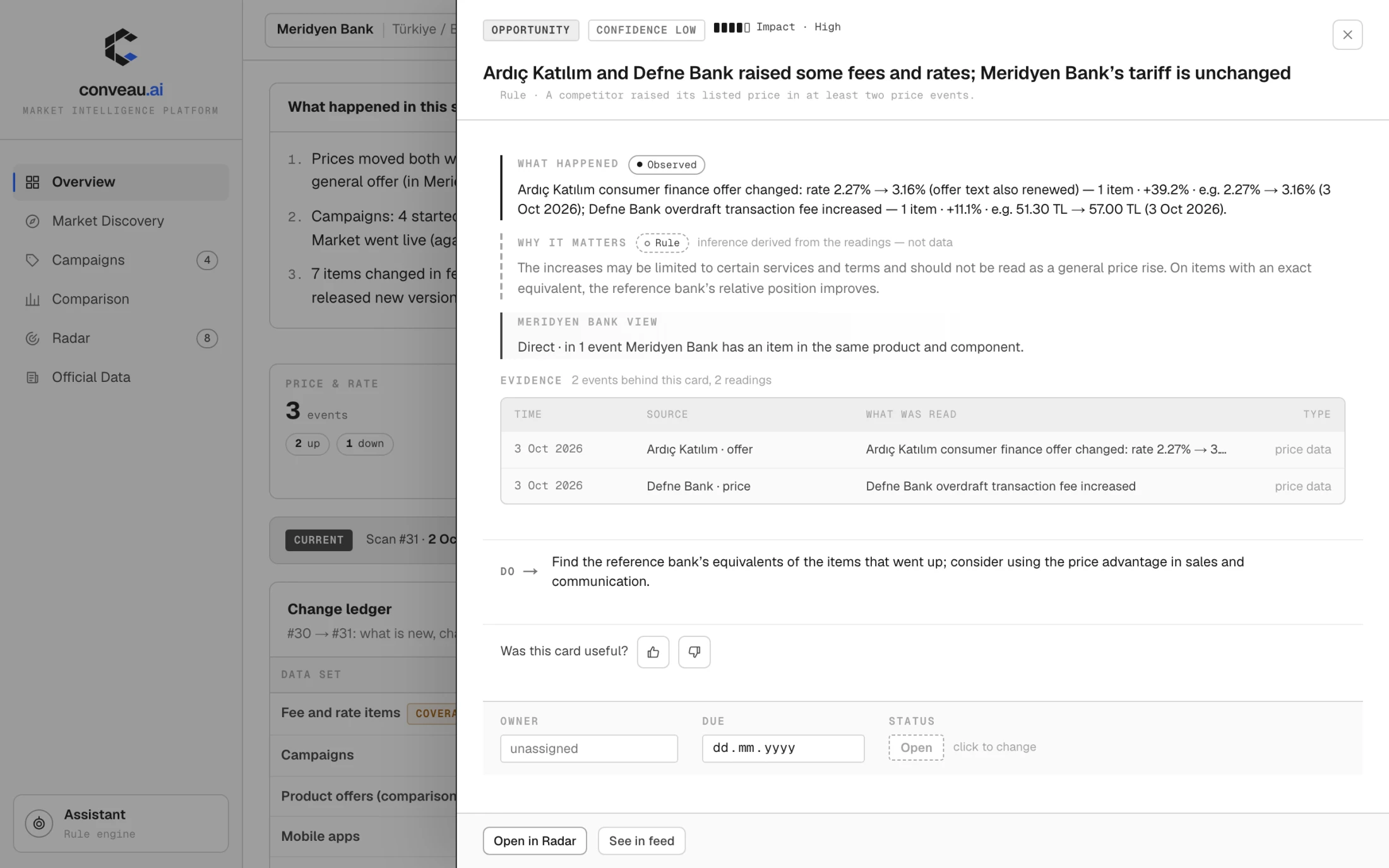
Events are grouped into cards — opportunity, threat, strategy, watch — and each card separates what was observed from what was inferred, lists the readings it was built from and proposes a next step that can be given an owner and a due date.

  • "Observed", "Rule" and "Model" are labelled on every line
  • Impact and confidence scored separately
  • A briefing per scan you can share as it is
Radar briefing with an opportunity card, its reasoning and evidence table
A radar card opened: what happened, why it matters, evidence, next step, owner and due date

Market Discovery

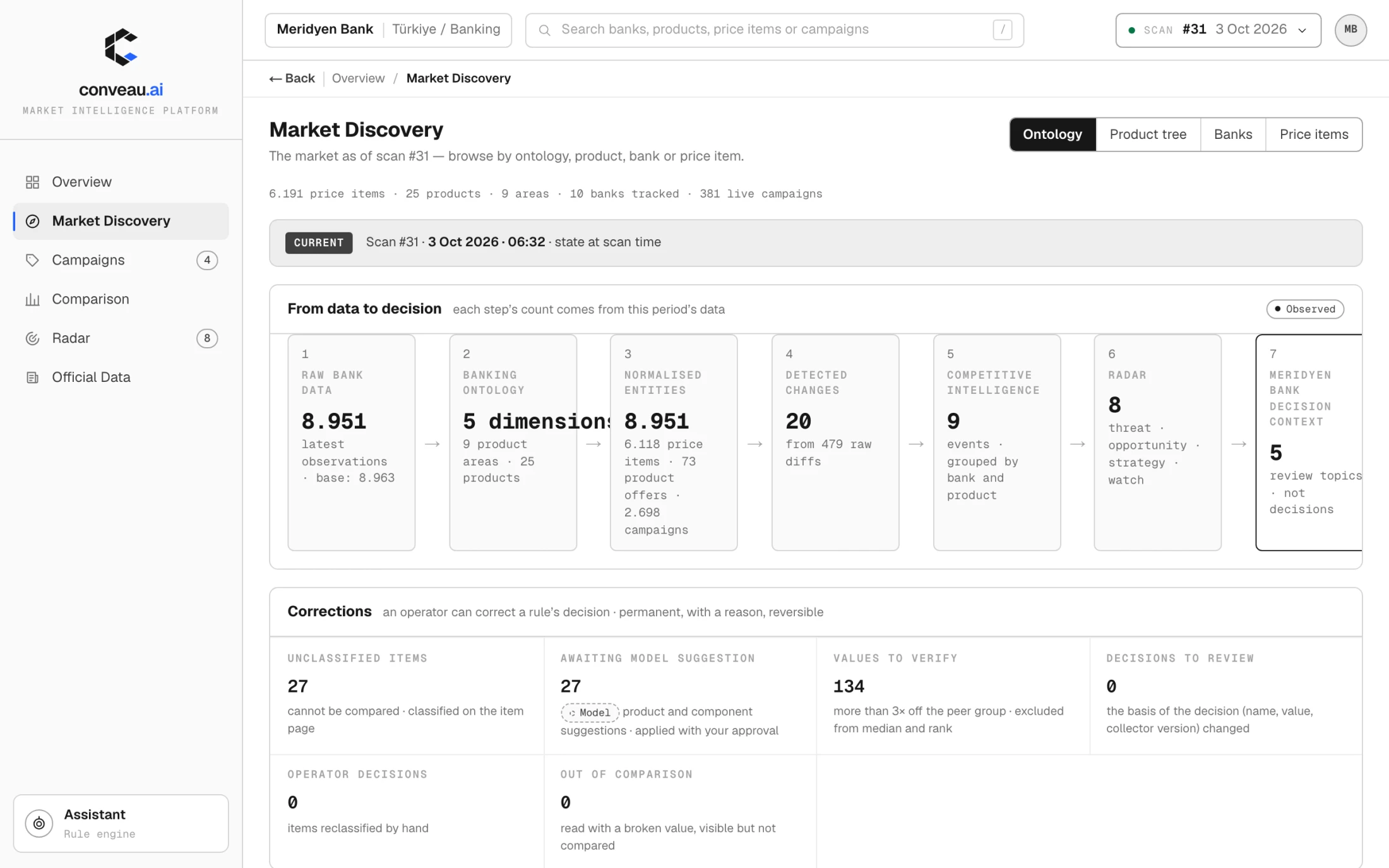
From raw pages to a decision, with the count at every step.

Raw readings are normalised onto one ontology of products and price items, so the same thing has the same name whoever publishes it. You can walk the market by product, by company or by item — and see how many records survived each step.

  • One ontology across every competitor
  • Unclassified and out-of-range values are queued, not guessed
  • An operator can correct any decision, and it sticks
Market discovery: the pipeline from raw data to decision context, with counts per step

Assistant

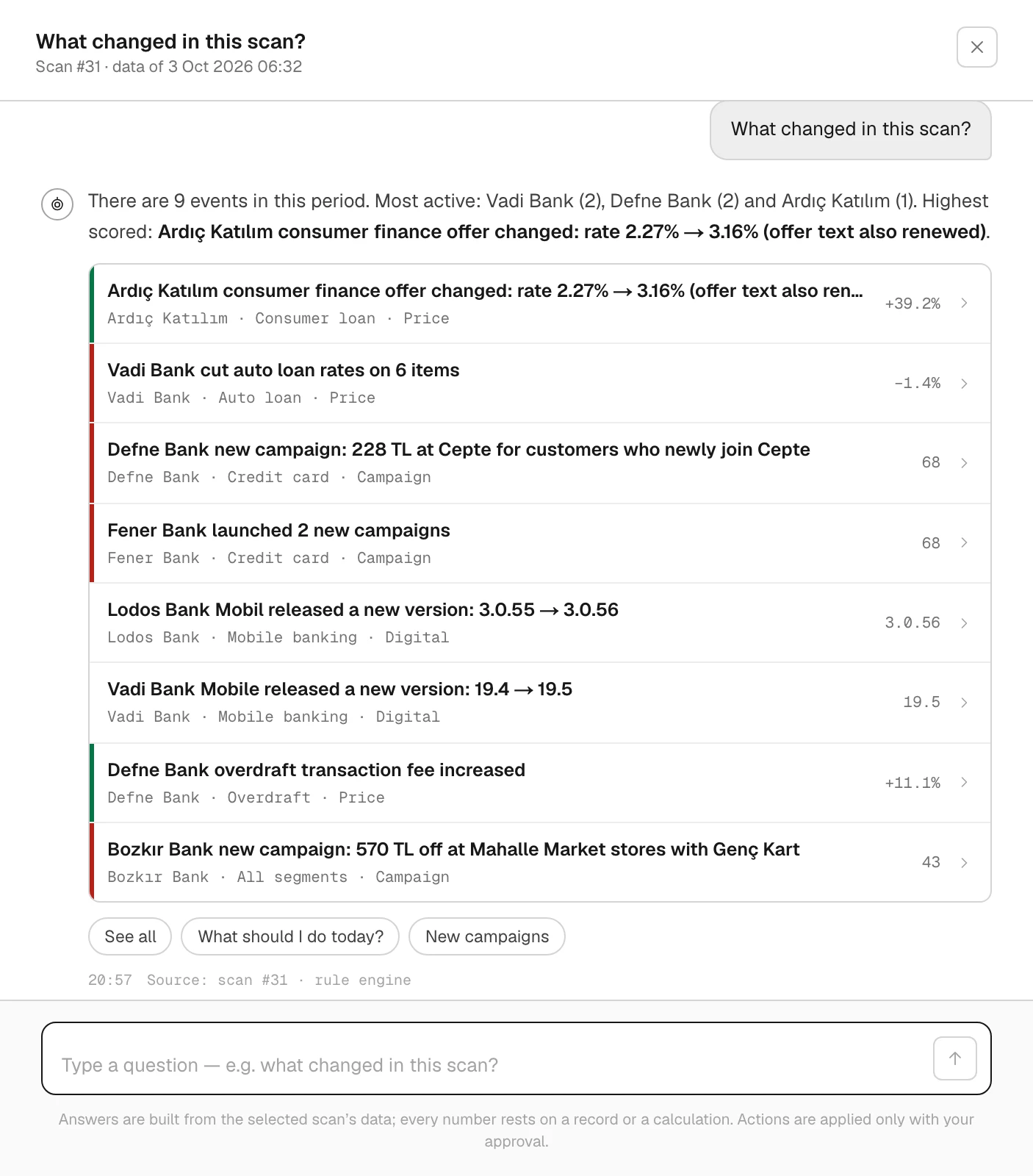
Ask what changed. Get records, not paragraphs.

The assistant answers from the selected scan only. Every number in a reply is a record or a calculation you can open, and nothing is applied without your approval.

  • Answers link to the event behind them
  • Runs on rules alone when you want no model in the loop
  • "What should I do today?" is a question it can answer
  • What changed in this scan?
  • What should I do today?
  • New campaigns
Assistant answering "what changed in this scan?" with a list of linked events

From a competitor’s web page to a decision with an owner.

Four steps, the same on every scan. Each one keeps its count, so you can see how the raw readings became the few things worth looking at today.

  1. Collect

    Scheduled scans of the open market

    Competitor sites, catalogues, tariffs, campaign pages, comparison portals and app stores are read on a regular schedule.

  2. Normalise

    One ontology, matched like for like

    Each reading is placed on a shared product ontology and matched to its equivalent in your own portfolio.

  3. Detect

    Real change, separated from noise

    A moved page address is not a price change. Artefacts, reversals and metadata edits are counted apart from the events that matter.

  4. Decide

    Cards with evidence and an owner

    Radar groups events into prioritised cards. Each one proposes a next step and can be given an owner and a due date.

See it on your own market.

A 30-minute session. Tell us who you compete with and what you need to track, and we will walk you through the platform on that basis.

We reply within one business day.

  • No commitment for the first session
  • Scope and price agreed before any work starts
  • Start with one market, add more later
Rather write to us? Contact